
Background
Despite its economic opening over the last 2 decades, Lao PDR remains among the least developed countries in the world, ranking 138/177 on the Human Development Index.
According to UNICEF, a third of Lao children under 5 suffer chronic stunting. The rural population is the poorest in the country, mostly having no access to land/work, often showing a low level of education.
Poaching food for survival remains an obligation, leading to biodiversity degradation, wildlife species extinction, emergence and spreading of new diseases.
In addition, the main challenge to gender equality remains to enable women access to opportunities and resources, especially for rural and marginalized women. Food insecurity, illiteracy, economic disenfranchisement, poor reproductive and basic health are still high on the development agenda for women in the country.
The need for new tools to speed up development remains at a high level, in order to generate sources of income for women but also for vulnerable population such as disabled people, elders, and landless farmers.
In this regard, the development of a sustainable edible cricket value chain could offer a great opportunity to address this challenge.
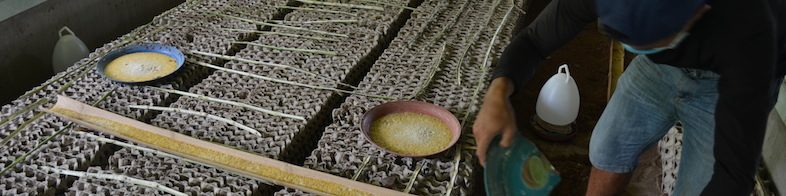
These insects are an important source of protein, requiring a very low investment for a significant return, with almost no waste. In addition, the use of inexpensive sensors to remotely monitor their growth can significantly increase their production yields. Finally, the extraction of high value-added products from their cuticle can also provide producers with a significant income.
Objectives
The aim of this project is to supports the implementation of cricket breeding activity that is a sustainable activity for local women by providing a perennial income through a farmer’s contract with Cricket Lao Farm.
The Project can be categorized as an Integrated Conservation and Development Project.
Its conceptual framework implies the assumption that biodiversity conservation outcomes are inextricably linked to rural development.
We consider that:
- Alleviating poverty increases the interest and capacity for natural resource conservation (sustainable economic development approach),
- Offering a new source of regular income can reduce the impact on natural resources gathering (alternative livelihood approach),
- Involving local people in the planning and management of natural resources and in the sharing of benefits leads to better livelihood (Participatory planning approach).
Ultimate goal
To provide vulnerable families with a combination of asset management support, productive assets and coaching to strengthen their economic security and resilience link to forest conservation. Insect farming is a promising way to increase incomes.
The activity is adapted to the local context of targeted Households, and promotes social inclusion for women or persons with disability with limited resources (non labour intensive, no land required).