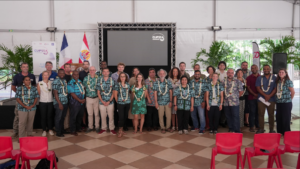
The Science-Management Days, held on 23 and 24 June, marked the closing week of the CLIPSSA project. Hosted at the Presidency of French Polynesia in Papeete, the event brought together public authorities, researchers and representatives of civil society to explore how the findings of this research-action project can help anticipate the risks posed by climate change.
©Fabrice Charleux
CLIPSSA: Understanding the Climate to Anticipate the Future
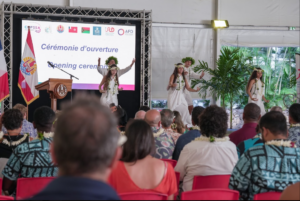
“The significance of this achievement is immense because, in the Pacific, science is not merely an added value or an optional source of expertise.” Moetai Brotherson, President of French Polynesia
©Fabrice Charleux
Thanks to the invitation and co-organisation of the Government of French Polynesia, IRD, Météo-France and the French Development Agency (AFD) welcomed the CLIPSSA project focal points from across the four participating territories. Participants included representatives from the Directorate of Agriculture of French Polynesia; the Department of Agriculture, Forestry and Fisheries and the Department of the Environment of Wallis and Futuna; the Vanuatu Meteorology and Geo-Hazards Department (VMGD); as well as representatives from the Government of New Caledonia, North Province, South Province, Technopole Nouvelle-Calédonie and the Bio eKo Consultants consultancy. Together, they took part in the closing week of the CLIPSSA project.
Diverse Discussions on Climate Change Adaptation
“CLIPSSA was built upon a strong conviction: responding to climate challenges requires bringing together disciplines and different forms of knowledge.” Mélanie Roué, IRD Representative in French Polynesia
Held on 23 and 24 June, the Science-Management Days created a direct link between scientific knowledge and public action at the Presidency of French Polynesia. Opened in the presence of President Moetai Brotherson and members of his government, the event enabled the CLIPSSA scientific team to work alongside government departments and public services from the territories under study in identifying possible adaptation pathways for the near future, drawing on the project’s scientific findings. This work took place through a series of creative workshops designed and facilitated in close collaboration with the teams from the Directorate of Technology and Innovation (DTI) of the Government of French Polynesia. These Science-Management Days were built directly upon the intermediate conference held in Nouméa in March 2025, which established a genuine space for dialogue between researchers, public authorities and territorial stakeholders. The objective of both events has been to foster the uptake of CLIPSSA’s scientific findings while supporting the co-development of adaptation strategies capable of responding to the expectations and needs of local communities.
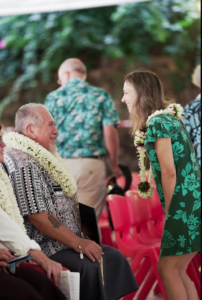
Moetai Brotherson and Mélanie Roué ©Fabrice Charleux
A total of 107 participants attended the two-day event, including the scientific teams and the DTI facilitators. Participants represented government departments, project partners—including Météo-France and AFD—local authorities, non-governmental organisations, the agricultural sector and the four territories involved in the CLIPSSA project. One of the main challenges of the event was to address the distinct expectations of the different stakeholder groups. Researchers, public authorities and civil society did not seek the same types of information nor pursue the same objectives.
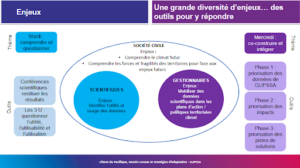
To respond to these different needs, the workshops were designed around three complementary questions:
- How can the usefulness and potential applications of scientific data be identified?
For researchers - How can scientific evidence be integrated into public policies and adaptation plans? For public authorities and decision-makers
- How can future climate conditions, together with the strengths and vulnerabilities of the territories, be better understood in order to prepare for future challenges?
For civil society
©Maya Leclercq
Understanding and Taking Ownership of the Results
“Having access to these climate data is invaluable for guiding our experimental work and for better characterising how our crop varieties will respond to climate change.”
Sébastien Blanc, Head of the Tropical Root Crops Centre, Technopole Nouvelle-Calédonie
The first, entitled “Understanding, Questioning and Taking Ownership”, focused on presenting CLIPSSA’s main scientific findings. The second, “Co-designing and Integrating”, held on Wednesday morning, aimed to support participants in collectively reflecting on how these scientific findings could be incorporated into territorial adaptation planning.
©Fleur Vallet
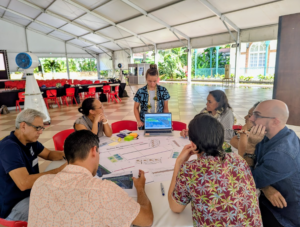
During the afternoon, participants took part in a series of mini-conferences organised around five key themes:
- Temperature projections
- Tropical cyclones
- Precipitation
- Agricultural impacts
- Local knowledge
Working in small groups, participants rotated between the different scientific teams. Each session combined a concise presentation of the research findings, a discussion with the researcher leading the session, and a collective reflection structured around the “Three Us”:
- Utility – How useful are these findings?
- Usability – Can they realistically be used by stakeholders?
- Use – How can they be translated into concrete action?
This format enabled every participant to attend each thematic presentation while encouraging direct dialogue with the researchers. The summaries produced at the end of each workshop now constitute valuable working material for identifying which scientific findings are considered most relevant by the various stakeholders, as well as the conditions required for their effective mobilisation in public decision-making.
Integrating Knowledge and Taking Action
“How can these scientific findings be incorporated into public adaptation policies?” Fleur Vallet, Geographer and CLIPSSA Project Coordinator, IRD
©Fabrice Charleux
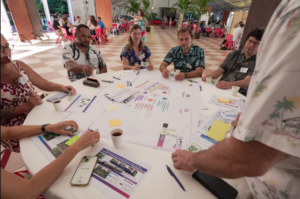
On Wednesday morning, the programme continued with a workshop sequence dedicated to integration. Building upon the scientific findings presented the previous day, participants were invited to identify the information they considered most relevant, assess its potential implications for their territories, compare these findings with the climate plans available to them, and finally develop a series of possible adaptation measures.
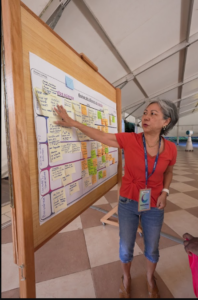
The morning concluded with a gallery walk, during which participants visited each group’s work to discuss the proposed ideas, followed by a Samoan Circle. This facilitation method created an open and inclusive space for participants to share their experiences, encouraging both active listening and collective dialogue. The objective was not to produce immediate operational solutions. Rather, the workshops were designed to initiate a collective learning process, enabling participants to experiment with a working method grounded in the integration of scientific evidence into territorial planning and climate adaptation processes.
On Wednesday afternoon, the momentum generated during the Science-Management Days continued with a workshop dedicated to strengthening the adaptation component of the French Polynesia Climate Plan (PCPF). The workshop was organised by the consultancy K Ora as part of its project management support to the Department of the Environment (DIREN).
Building directly upon the work carried out within CLIPSSA, the workshop aimed to take the process one step further. Whereas the previous sessions had enabled participants to understand and take ownership of the climate data and to identify priority climate impacts, this workshop focused on comparing these findings with existing public policies in French Polynesia. Participants assessed whether the adaptation measures already included in the Climate Plan were sufficient and explored opportunities to strengthen them by drawing inspiration from adaptation initiatives implemented in comparable island contexts.
The workshop brought together representatives from several government departments around an island archetype approach, distinguishing between high islands with barrier reefs, the Tuamotu atolls and urban centres. This approach encouraged participants to move beyond sector-specific perspectives and begin designing adaptation strategies from an integrated, cross-sectoral perspective.
Planning for the Future Rather Than Enduring It
“We all come from island states and face common challenges arising from the impacts of climate change and extreme weather events on our ways of life.”
Antfalo Levu Boaz, Director of the Vanuatu Meteorology and Geo-Hazards Department (VMGD)
Participants’ feedback highlighted a strong appreciation for the workshop format. The mini-conferences encouraged direct exchanges between researchers and participants, while the presence of facilitators fostered active participation from audiences with diverse backgrounds and areas of expertise.
The presentations dedicated to Climate Science, Social Sciences and Humanities (SSH) and Agricultural Impact Modelling generated particularly rich discussions, reflecting the strong interest shown in these three complementary components of the CLIPSSA project.
The workshops held on Wednesday morning further confirmed this positive dynamic. The scientific resources made available throughout the event were widely used by participants, and the working groups rapidly embraced the proposed methodology, establishing numerous connections between CLIPSSA’s scientific findings and the strategic priorities already identified within their respective territorial climate plans.
These two days demonstrated that sustained dialogue between researchers, public authorities and civil society can lead to concrete outcomes that are both scientifically robust and closely aligned with the needs of local communities.
If this collaborative dynamic continues through the long-term uptake of CLIPSSA’s scientific findings by public authorities, the project has the potential to support the development of adaptation strategies capable of guiding public action to safeguard Oceanian ways of life in the decades ahead.
For those wishing to relive the event, a highlights video is available on the CLIPSSA website and on the IRD YouTube channel. The full programme of the Science-Management Days, together with the presentations delivered on Tuesday 23 June, is also available here.