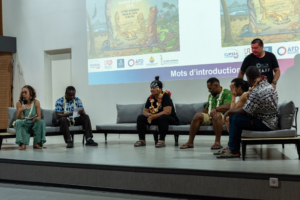
Screening of the documentary The Marriage of Knowledge followed by a panel discussion on the adaptation of Oceanian agriculture to climate change.
©Fabrice CHARLEUX
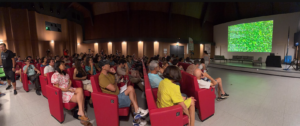
On Friday, 26 June 2026, Te Fare Iamanaha – Museum of Tahiti and the Islands hosted a public evening event organised as part of the Oceanian Conference of the CLIPSSA project. Conceived as a forum for dialogue between researchers, farmers, institutional representatives and citizens, the event brought together more than one hundred participants around a common question: How can we build more resilient agricultural systems in the face of climate change?
Structured around the screening of the documentary The Marriage of Knowledge, followed by a panel discussion, the evening illustrated one of the core principles underpinning the CLIPSSA project: effective responses to climate challenges are built through the combination of scientific knowledge and the local knowledge developed by the communities of the South Pacific.
A Documentary Chronicling Five Years of Collaborative Research
©Fabrice CHARLEUX
Directed by Jean-Michel Boré, IRD filmmaker, and co-produced by IRD and the French Development Agency (AFD), The Marriage of Knowledge retraces the scientific and human journey of the CLIPSSA project through the voices of researchers, farmers and residents of the territories involved in the project. Screened in French with Tahitian subtitles with an English audio transcript, the documentary highlights the richness of the exchanges between scientific research and local knowledge that shaped the project throughout its five years.
A Panel Discussion Bringing Perspectives into Dialogue
©Fleur VALLET et Maya LECLERCQ
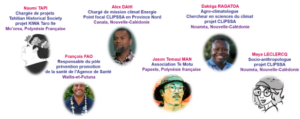
Moderated by IRD socio-anthropologist Maya Leclercq, the panel discussion brought together researchers, institutional representatives and agricultural-sector stakeholders from several South Pacific territories.
The discussion combined CLIPSSA’s scientific findings with participants’ lived experiences in the field, fostering helping build a shared understanding of the challenges ahead. One central message clearly emerged: adapting agricultural systems will only be possible by bringing together scientific knowledge and the local knowledge held by communities.
The discussion focused on several major themes:
- Transmission of local agricultural knowledge;
- Impacts of climate change already being observed across the territories;
- Limitations of imported agricultural models;
- Governance challenges;
- Role of research in supporting public decision-making.
Local Knowledge as the Foundation for Adaptation
One of the evening’s key messages was that the territories of Oceania already possess a remarkable body of environmental knowledge. Alex Dahi, Climate Officer for North Province, New Caledonia, emphasised that traditional agricultural systems are the result of generations of observation, experimentation and adaptation. This continuous transmission of knowledge has enabled communities to develop farming practices closely adapted to local environmental conditions and now represents an essential resource for addressing the challenges posed by climate change.
One of CLIPSSA’s objectives is precisely to document this local knowledge in order to better understand how it can inform public policies and territorial adaptation strategies. Building on this idea, Maya Leclercq explained that the project’s ambition is to scale up these local experiences. Rather than remaining isolated examples, they can provide lessons capable of informing broader territorial adaptation strategies and supporting decision-making across the South Pacific.
Observing Climate Change on the Ground
The testimonies shared by the farmers served as a reminder that the impacts of climate change are no longer confined to scientific projections. They are already being experienced in the field. On Moorea island, Naumi Tapi described the changes observed in the taro fields of Maison Kellum. She spoke of the growing challenges posed by increasingly intense heat, shifting rainfall patterns, the difficulty of working outdoors during the hottest hours of the day, and the ongoing struggle against soil erosion.
Her testimony illustrated how agricultural adaptation begins with the day-to-day observation of environmental change. Jason Temaui-Man, President of the Te Motu Association, expanded on this discussion by questioning the relevance of imported agricultural models. In his view, tropical food crops such as taro, cassava and Kanak cabbage are particularly well suited to local environmental conditions and should play a central role in future adaptation strategies. He also warned that some Pacific islands could eventually reach a “habitability threshold”, further reinforcing the urgency of adapting agricultural systems today rather than waiting for future crises.
When Research Informs Action
CLIPSSA’s scientific findings provide a deeper understanding of these observations made in the field. Among the results presented, Dakéga Ragatoa highlighted research on the impacts of increasing temperatures on agricultural activities. Climate simulations indicate that rising temperatures could progressively reduce crop yields, with direct consequences for farmers’ incomes and regional food security.
He also emphasised that practices such as agroforestry and mulching already offer promising adaptation options for reducing the impacts of extreme heat on crops. The discussion clearly demonstrated the complementarity between farmers’ observations and scientific research. Field experience makes it possible to identify the transformations already underway, while scientific evidence provides the tools needed to anticipate future changes and support informed public decision-making.