Farmers in the Pacific confronting climate change
On 2 December 2025 at 6 p.m., the South Province auditorium hosted a C’Nature conference dedicated to agriculture and adaptation to climate change. On this occasion, researchers from the CLIPSSA project shared their various works: Catherine Sabinot (anthropologist and ethnoecologist), Maya Leclercq (anthropologist and sociologist, via videoconference from French Polynesia), and Samson Jean-Marie (PhD student in anthropology and geography), as well as Ida Palene, a former intern who is now a civic service volunteer with CLIPSSA. Together, they discussed a key question:
How, particularly in South Pacific societies, do farmers observe climate change in their immediate environment? Do they experiment with concrete responses, and do they pass on knowledge and practices to better adapt to it?
In the Pacific islands, agriculture is practised in close harmony with the seasons, the soil, the winds, the rain… and extreme events. Knowing how to anticipate a very dry period, reorganise crops after heavy rains, or prepare for the approach of a cyclone is part of daily life for many families. At the heart of the discussions is a powerful idea: the communities of New Caledonia, Vanuatu, Wallis and Futuna, and French Polynesia have built, through experience, genuine ‘cultures of risk’. In other words, ways of observing, interpreting and acting that enable them to cope with climate uncertainty. The challenge today is to combine this knowledge and these practices with scientific knowledge in order to strengthen adaptation.
Recognising and identifying vulnerabilities in the face of a real climate threat
During the conference, researchers highlighted the transformations of weather and climate mechanisms driven by climate change, particularly the ENSO mechanism, which causes year-to-year fluctuations in rainfall and temperature. They explained how these changes affect agricultural crops, harvests, and water storage.
Dry seasons tend to be longer and more intense. They hinder crop growth, cause water stress, dry up water sources, and make the soil harder to cultivate. Conversely, severe flooding leads to plant diseases and destroys crops. In both cases, communities must adopt new water management strategies and prepare for shifts in agricultural yields. The climate emergency therefore raises pressing concerns about food security.
“The hardest part is water. The dry season lasts longer; the small creek there (…) just stones, stones (…) we have to choose which field to save.” Farmer from Canala, New Caledonia, January 2024
Hybridising knowledge: a tool and space for resilience
During the presentation and subsequent discussions, the CLIPSSA team described knowledge hybridisation as an active, living process. It can be defined as the combination of endogenous knowledge (inherited from ancestors, embedded in genealogy, and passed down through generations) and exogenous knowledge (from external sources such as NGOs, scientific research, social media, etc.). Over time and through climate events, farmers experiment with new practices and generate new forms of knowledge, shaped by their own experience and the various resources available to them.
Researchers described several practices and techniques observed in New Caledonia, Vanuatu, French Polynesia and Wallis and Futuna: mulching, angled staking, crop diversification, selecting more resilient seed varieties, and innovations in irrigation. They also showed how learning spaces and moments are diversifying, involving nakamals, kava bars, schools, markets, fields, and small Oceanian home gardens such as fa’a’pu, as well as social media and various forms of media. These spaces and moments—these evolving socio-temporal settings—move beyond conventional pathways and societal norms, enabling adjustments in agricultural practices within climate contexts that are themselves constantly changing.
Part of the conference was dedicated to the role of women in the circulation of knowledge, highlighting the essential yet often invisible role they play.
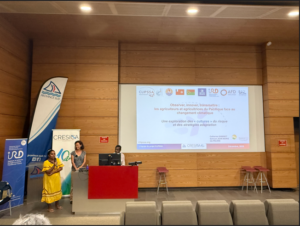
Ida Palene, agricultural engineer, presenting her research on the role of women in the circulation of knowledge.
Photo credits: Marie Baritaud.
How did the researchers work with local communities?
Through semi-structured interviews and participant observation, researchers worked alongside farmers to make visible the lived experiences of local communities facing climate change and to highlight the ways in which knowledge circulates.
They organised participatory mapping workshops, during which participants spatialised cultivated areas exposed to various climate hazards. They also collaborated with schools, notably through drawing workshops that revealed the representations and knowledge of the younger generation.
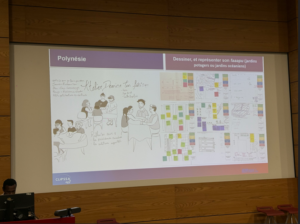
@crédits photos Marie Baritaud
The C Nature 2025 conference once again demonstrated the importance of combining local knowledge with academic research. Farmers experience the direct impacts of climate disruption and, on a daily basis, develop ways of forecasting weather conditions and adapting to them. Through trial and error, as well as success, they build a genuine culture of risk. By merging endogenous local knowledge with exogenous knowledge, adaptive strategies emerge that resonate more closely with those who work the land — and which deserve to be more fully integrated into public policy.