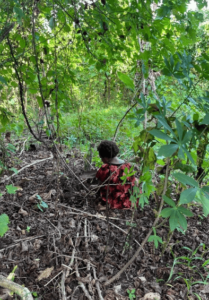
Woman in her field, @credits photos Ida PALENE
End-of-studies internship carried out by Ida PALENE
ISTOM: School of Engineering in International Agricultural Development
February–August 2025
Supervisors: Samson JEAN MARIE (IRD), Catherine SABINOT (IRD)
Fieldwork: Vanuatu
Defence on 23 October 2025 in Angers in the presence of two professors who are members of the jury: Brice EBODE, lecturer and researcher in geosciences and the environment, and Smail Slimani, lecturer and researcher in hydrogeology at ISTOM.
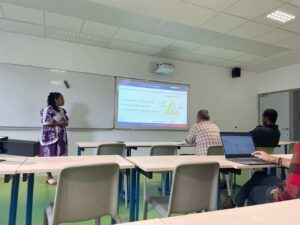
Ida during her thesis defense in Angers, @crédits photos Ida PALENE
In two rural villages in the Vanuatu archipelago, women farmers are reinventing agricultural practices, solidarity and gender roles on a daily basis to cope with climate and social upheaval. Ida Palene, a young agro-development engineer, went to share their daily lives.
Abstract
This thesis analyses the central role of rural women in adaptation dynamics in the face of climate, social and environmental change, based on two communities in Vanuatu: Ipayato (south-west of Santo) and Epao (east of Efate). It documents the diversity of agricultural practices, the circulation of knowledge, and social and gender restructuring in vulnerable island contexts.
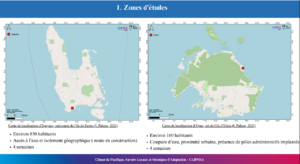
Figure 1:Location map of the sites studied in Vanuatu 2025 (I. PALENE)
Study context
Multi-sited ethnographic approach, based on an eight-week immersion, participant and non-participant observation, landscape observation, semi-structured interviews and participatory mapping.
The main sample consists of forty women, interviewed about their agricultural practices, their organisations, their difficulties, their trajectories and perceptions of change.The methodology focuses on territorial practices, social logics of transmission and adaptation to uncertainty.
Key findings
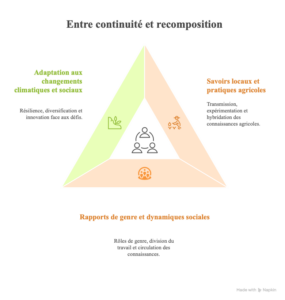
The study conducted in the villages of Ipayato (Santo) and Epao (Efate) shows that rural women in Vanuatu play a strategic role in building resilience on a daily basis. Through their agricultural practices, knowledge and collective commitments, they ensure the continuity of production systems while reinventing them. Three dimensions structure this dynamic:
- Climate and social adaptation
Women initiate forms of agricultural diversification, shared resource management and community cooperation. These initiatives result in discreet technical innovations, rapid adjustments to hazards and a silent redistribution of tasks linked to male mobility.
- Hybrid knowledge and learning
Adaptation combines local heritage and external learning. Women farmers reinterpret endogenous know-how in the light of institutional contributions, combining observation, experimentation and critical selection. This hybridisation reveals an ability to filter and recompose knowledge according to its social and environmental relevance.
- Gender relations and social innovation
Women’s associations, savings groups and working collectives act as laboratories for social innovation. They combine family solidarity and institutional forms of mutual aid, opening up new spaces for decision-making and visibility for women in the rural public sphere.
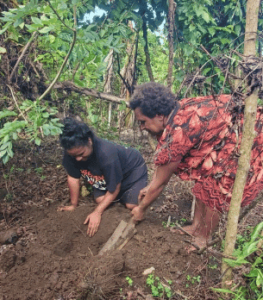
Yam harvest @ photo credits Samson Jean Marie.
Discussion
A cross-analysis of interviews, observations and participatory mapping highlights the importance of cultivated space as a living archive of knowledge and social relations. Plots of land, agricultural routes and shared spaces reflect constant negotiations between generations, between men and women, between customary norms and injunctions
The use of participatory mapping as a collaborative research tool has made it possible to reveal often implicit knowledge and bring to light the plurality of representations of the territory. The spatial approach has proved fruitful in articulating qualitative data, social dynamics and perceptions of risk, offering a detailed reading of differentiated vulnerabilities.
These results argue for an understanding of adaptation as a cultural and relational process, rather than a simple technical response. By integrating elements external to their local references, women are redefining modes of action and authority within their communities. Adaptation thus appears as a movement to reshape knowledge, roles and forms of local governance.
Conclusion
This research sheds light on the social plasticity and creativity of rural women in Vanuatu in the face of climatic and social uncertainties. Adaptation manifests itself as a complex interweaving of agricultural practices, social structures, gender relations and territorial inscription.
The female figures encountered embody an ecology of knowledge in motion, based on continuity, experimentation and collective reinvention. Participatory mapping, integrated into the ethnographic approach, played a central role in making this localised knowledge visible and in the shared construction of knowledge.
By placing women at the heart of the dynamics of transformation, this study invites us to consider adaptation policies not as instruments imposed from above, but as processes rooted in everyday life, shaped by the relationships, choices and knowledge of the communities themselves.
Read her thesis defence presentation, her thesis.