Credit: @Jean-Michel BORE
Four years of groundbreaking interdisciplinary research have come to a close: By bringing together climate science and social science, the CLIPSSA project set out to rethink the future of agriculture alongside Ni-Vanuatu communities—proving that when science meets local knowledge, powerful solutions emerge.
The CLIPSSA project (2021–2026) is reaching the end of four years of unprecedented interdisciplinary research, and the results obtained in Vanuatu reveal a crucial finding: an interdisciplinary approach proves both beneficial and highly relevant.
From April 28 to May 7, workshops held in Ipayato, Epao, and Mangaliliu villages, alongside several conferences in Santo and Efate, brought together climate projections, agricultural simulations, and local knowledge. At the centre of discussions were the future of agricultural production, climate risk management, and concrete adaptation practices already implemented by Ni-Vanuatu farmers. These meetings showed that a more resilient agriculture is built as much in scientific models as in gardens, village discussions, and shared experiences.
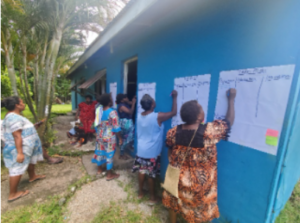
Catherine SABINOT, Samson JEAN MARIE, Gildas GUIDIGAN, Hong-Hanh LE, and Ida PALENE, researchers at IRD, travelled to Vanuatu from April 28 to May 7 to present CLIPSSA results to farmers in Ipayato (South Santo), Epao (East Efate), and Mangaliliu (West Efate). This period of exchange allowed the team to present key findings, share educational materials (posters, etc.), and finalize a collaborative body of work. In total, 300 people participated in these outreach sessions.
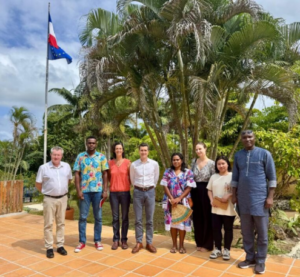
Credit: @French Embassy in Vanuatu
Outreach sessions were also held for the Vanuatu Agricultural Research and Technical Centre (VARTC) and the Vanuatu Meteorology and Geohazards Department (VMGD). Additionally, a lecture was given at the National University of Vanuatu on May 6, followed on May 7 by a meeting with the Ambassador of France in Port Vila to discuss these findings.
What Did CLIPSSA Produce in Terms of Climate Projections?
Global climate models are not fine-grained enough to account for the specific features of South Pacific islands. To accurately capture the unique characteristics of these islands, CLIPSSA utilizes high-resolution climate models in collaboration with Météo-France, including ALADIN (20 km resolution) and AROME (2.5 km resolution)—a process known as dynamic downscaling.
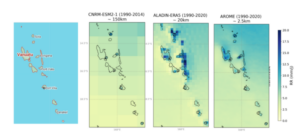
Average daily precipitation from 1990 to 2020.
By the end of the century, climate projections carried out under the SSP3-7.0 scenario outline a clear trend for Vanuatu: the country will continue to warm. The regional average temperature could increase by approximately +1.1 °C between 2036 and 2065, reaching nearly +2.6 °C between 2071 and 2100 (relative to a baseline reference period of 1991–2020).
While the overall long-term trend in annual rainfall remains uncertain, the findings indicate an increased risk of drought, including during the traditionally wet season (November to April). Heatwaves are also projected to become more frequent, averaging 4 to 6 days between 2036 and 2065, and up to 9 days between 2071 and 2100.
What Are the Results for Taro and Yam Crops?
Using the APSIM-NextGen crop simulation model (driven by climate and agronomic data specific to the region), researchers observed a significant drop in potential yield for taro production—particularly the Fiji variety, which is a water taro. Rising temperatures will act as a major constraint, causing yield instability of up to -60% by the end of the century. Furthermore, the recovery time for crops following a climate shock will increase from 1 to 4 years today up to 8 years by 2071.
Conversely, yam appears significantly more resilient, demonstrating high robustness:
- Dioscorea alata (DA): Maintains stable yields and a fast recovery time (1 to 2 years) throughout the century.
- Dioscorea esculenta (DE): Emerges as the most resilient variety, recording its highest yield gains (+42%) under the driest scenarios.
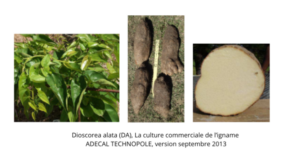
Vanuatu is thus facing a major shift in crop viability. As observed in field evaluations, the primary strength of local agricultural production lies in crop poly-culture (growing multiple crop species together).
Knowledge in Motion: Women, Local Roots, and Plural Spatio-temporal Scales
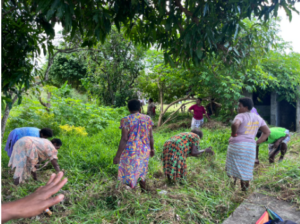
(Credit: @Ida PALENE / @Samson JEAN-MARIE)
The core originality of CLIPSSA relies on its collaborative approach: local populations are not mere beneficiaries, but active co-producers of knowledge. In Vanuatu, months of ethnographic field research mapped out the vitality and flow of traditional local knowledge. The diversity of local adaptation strategies and the ways they spread can directly inform public policy regarding spatial planning and land development in response to climate change.
©Samson JEAN-MARIE