

Traditional Pacific Crops Facing the Threat of Climate Change
On June 2, 2026, the South Province of New Caledonia, in partnership with CRESICA, hosted a public conference as part of the C’Nature series dedicated to the impacts of climate change on island agriculture. On this occasion, two postdoctoral researchers in climate science from the CLIPSSA project, affiliated with the IRD (French National Research Institute for SustainableDevelopment), Gildas Guidigan and Dakéga Ragatoa, presented the major findings of the agronomic component of their work. Together, they provided answers to a question that seems simple on the surface, yet is central to food security in Pacific territories: what is the future of tropical root crops—taro, yam, and cassava—in the face of rising temperatures in Wallis and Futuna, French Polynesia, Vanuatu, and New Caledonia between now and the end of the century?
Why Focus on Tropical Root Crops?
Yam, taro, and cassava are not merely subsistence crops. The researchers, in consultation with the governments and provinces concerned, recalled their symbolic and social significance: They are symbols of tradition and identity, legacies passed down through generations, sources of food and solidarity, and markers of resilience and pride in Oceanian societies. Global warming and its direct consequences on subsistence farming thus pose a concrete question: how can we prepare for it, and through what means? The study focused on specific varieties, including Veo, Taloulu, Vegi ulu liliki or Vegi kau’i ti, Fiji taro, Kari, Florido, Taiwata, Maniota Ufi, and Manioka (Manihot esculenta).
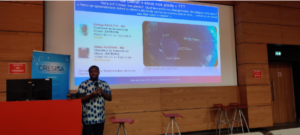 Dakéga Ragatoa ©Willis Waweru
A Cascading Methodology: From Regional Climate to the Crop Field
To address this question, the team developed a multi-step modelling framework. Projections from the IPCC global climate model (resolution of approximately 100 to 200 km) were refined through regionalization using the ALADIN (~20 km) and AROME (~2.5 km) models developed under the CLIPSSA project, as well as additional debiased regional models from the SOCLE-OM project (NIWA from New Zealand, AUS-CORDEX from Australia).
These climate data then feed into the APSIM Next Gen (APSIM-X) agronomic model, which simulates daily plant growth. The selected varieties were modelled using the APSIM-Potato module. Data availability varies across territories: New Caledonia possesses relatively comprehensive climate, soil, and agronomic data, whereas for Vanuatu, French Polynesia, and Wallis and Futuna, only climate data were directly used, with other parameters extracted or estimated from scientific literature and existing technical sheets.
Scientific Modelling in the Service of Food Security
To anticipate potential yield declines, the scientific team cross-referenced climate models with the APSIM plant-growth simulation model to spatialize (after calibration and validation) projections at a very fine scale (2.5 km grid cells). This tool integrates soil characteristics, atmospheric parameters (temperature, rainfall, solar radiation), and agronomic data collected in the field, allowing researchers to simulate plant development from planting through to potential yield (biomass and water use).

Gildas Guidigan ©Willis Waweru
A Warning for Taro Varieties, but Greater Resilience in Yam: Contrasting Findings
The results presented outline a worrying trajectory for taro, which is particularly sensitive to heat stress, while yam emerges as a pillar of resilience (in comparison to taro):
● Wallis and Futuna: Heat stress is already affecting crops. Under the SSP3- 7.0 scenario (equivalent to a +4°C increase in mainland France by 2100), local warming is estimated at +1.37°C by 2050 and +3.04°C by 2100 for the Alo and Hihifo sites. Simulations show a continuous decline in the average potential yield of all three crops—especially taro (talo ulu)—along with a sharp increase in poor harvest years by the end of the century. Heat stress emerges as the most decisive climate factor. Comparing the three crops, taro, cassava (manioka), and yam (vegi) all show slight declines in potential yield over time (taro losing the most), while cassava remains more stable—a finding that, according to researchers, calls for a reassessment of root-crop planning in the territory.
● French Polynesia: simulations focused on three specific crops: taro (Veo variety, Colocasia esculenta), yam (Dioscorea alata), and cassava (Maniota Ufi variety, Manihot esculenta). Spatialized outputs project a drop in potential yields compared to current observations. The sensitivity analysis conducted with APSIM-X confirms this downward trend for both crops and, as in other territories, identifies heat stress as the primary climate factor driving this decline (researchers note that at this stage, only climate parameters are considered, excluding non-climatic socio-economic or agronomic factors). Taro will suffer an alarming drop of around 29% in its potential yield as early as 2050. Bad harvest years could increase by up to 60% by 2070. High-production areas in Tahiti and Moorea will shrink, and cassava could cross the critical threshold of 50% losses in the rainiest sectors.
● Vanuatu: Fiji water taro will reach its thermal limits by the end of the century. Vanuatu faces the most concerning diagnosis of the presentation: Fiji taro, which is already experiencing significant heat stress, could lose up to 60% of its potential yield by 2100, with a marked acceleration in losses after 2050—with up to 46% of years classified as poor-yield years over the study period. Conversely, yam varieties (Dioscorea alata and Dioscorea esculenta) appear significantly more resilient, with losses limited to 5–19% depending on the models and varieties; Dioscorea esculenta is considered particularly reliable for future food security. Temperature, precipitation, and solar radiation all influence yields, with temperature remaining the dominant factor for taro. Researchers emphasize the need to prioritize the promotion of adapted yam varieties, farmer training, varietal diversification, adjusting planting dates, mulching, organic manure application, agroforestry, and establishing early warning systems, with special attention given to the northern islands of Vanuatu, identified as priority zones for adaptation investments.
● New Caledonia: In New Caledonia, the picture is more nuanced. Taro (CTT75 Kari), already close to its optimal temperature, is expected to see its yields gradually decrease (between -21% and -32% by the end of the century), with a sharp increase in poor harvest years after 2080 and a possible shift of cultivation areas to cooler regions; low-altitude coastal areas, particularly on the East Coast and in the North, could become unviable after 2060. Yam, on the other hand, shows overall higher robustness: the CTT100 Florido variety is projected to remain virtually stable until 2100 (a loss of 2% to 7% depending on the model) and, according to researchers, represents the priority crop for food security. Meanwhile, CTT230 Tiawata shows a moderate decline but remains productive and viable throughout the century. Notably, solar radiation and precipitation influence yam yields more than temperature, whereas temperature remains the main constraint for taro. Researchers recommend immediately expanding the cultivation of CTT100, diversifying heat-tolerant taro varieties, adjusting planting calendars before the 2040s, and implementing an early warning system for yield anomalies.
Diversifying and Anticipating: Keys to Agricultural Adaptation
Faced with the projected increase in “bad harvest years”, IRD researchers emphasize the urgent need to adapt farming practices in Oceanian gardens. The future of food sovereignty in these territories will depend on strategic choices co-designed with producers:
1. Varietal Adaptation: Promote heat-resistant replacement crops (such as Florido yam) and encourage farmers to mix multiple varieties and species in their fields to identify those best suited to climate variations.
2. Technical Adjustments: Advance planting dates (with shifting seasons) by 3 to 6 weeks to avoid heat peaks, implement widespread mulching to retain soil moisture, and optimize organic manure application.
3. Agroforestry: A practice that already exists locally but provides substantial microclimate benefits.
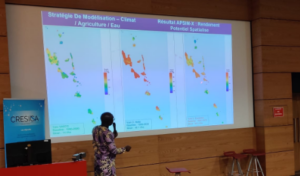
Gildas Guidigan ©Willis Waweru
Shared Messages Across the Pacific
Beyond the specificities of each territory, several common takeaways emerge: across all studied sites, heat stress is the single most penalizing climate factor for root crop yields, particularly for taro. However, water availability must not be overlooked, as water sources are also drying up with global warming. Yam consistently stands out as the most resilient crop (in this study) to climate change, making it a primary adaptation strategy (alongside other heat-resistant species and varieties) to bolster food security across Pacific territories, while cassava and especially taro appear more vulnerable depending on the zone. Finally, researchers stress that resilience does not mean an absence of risk: even the most stable varieties require proactive adaptation practices (varietal selection, crop calendars, soil and water management) before losses accelerate—particularly around the 2050–2060 horizon, which several models identify as a tipping point.
Translating Research into Public Policy
This conference served as a vital reminder of the absolute necessity to translate scientific research into concrete public policies. Facing climate disruption occurring literally “under our feet”, combining data-derived technical solutions with the daily experience of farming communities will be essential to strengthening resilience across the Pacific. The event concluded with a Q&A session, followed by expressions of gratitude in several Pacific languages (Māuruuru, Tankiu tumas, Malo, Oleti)—reflecting the strongly regional character of the CLIPSSA project. CLIPSSA brings together climate scientists, anthropologists, agronomists, and local communities around a single shared challenge: preparing the Pacific’s subsistence agriculture today for the climate changes of tomorrow.