After five years of research on the future climate of the South Pacific, the CLIPSSA research-action project has unveiled its findings at the University of French Polynesia. On 22 June, the research team presented to the scientific community its latest advances in understanding climate change across the island territories of the South Pacific (French Polynesia, Wallis and Futuna, Vanuatu and New Caledonia). Alongside the CLIPSSA team, researchers from other UPF research units also shared their expertise and findings on topics closely related to those explored within the project.
Bringing Results Back to the Territories Under Study
The CLIPSSA scientific team had the honour of being invited by the University of French Polynesia (UPF) to present the project’s scientific results. This invitation highlights the strong collaboration established between the scientific team, the RESIPOL network, and the researchers from the laboratories involved in CLIPSSA (GEPASUD and CRIOBE).
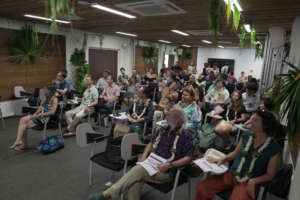
Held in the Research Auditorium of the University of French Polynesia, the event brought together scientists working across a wide range of disciplines. Presentations covered atmospheric modelling, legal approaches to climate issues, marine heatwaves, and the contribution of artificial intelligence to ocean modelling, illustrating the multidisciplinary nature of the research.
©Fabrice CHARLEUX
The aim of the day was twofold: to share the knowledge generated by the CLIPSSA project with the scientific community and to prepare the dissemination of the project’s results during the forthcoming Science-Management Days, bringing together stakeholders from the four territories studied: New Caledonia, Vanuatu, Wallis and Futuna, and French Polynesia.
For the Climate Science component, the results included the downscaling of the IPCC climate projections from an initial spatial resolution of approximately 100 km to 20 km, and even 2.5 km for selected areas. This significant increase in resolution provides much more detailed information on future climate conditions across the Pacific islands.
For the Social Sciences and Humanities (SSH) component, the team presented the outcomes of more than three years of field research investigating the resilience of Oceanian agriculture to the already observable impacts of climate change. The originality of the SSH approach lies in understanding how farmers are already adapting to climate change and in co-developing future adaptation plans together with them, based on their knowledge, practices and experience. To assess the impacts of climate change on crop production, impact modelling studies were also carried out to identify the challenges that Oceanian agriculture is likely to face and to provide a robust scientific basis for the design of future adaptation strategies.
The Future Climate of the South Pacific

“Ihi-ā-Hīro’a” association ©Fabrice CHARLEUX
The conference week began at the University of French Polynesia with an ʻŌrero, the traditional Polynesian art of public oratory, performed by a student from the Ihi-ā-Hīro’a association. This ceremonial opening followed a cultural and musical performance by fellow members of the association, setting the tone for a scientific event deeply rooted in the cultural heritage of the Pacific.
The scientific presentations were followed by speeches from Mélanie Roué, IRD Representative in French Polynesia, Catherine Sabinot, coordinator of the CLIPSSA Social Sciences and Humanities (SSH) component, and Fleur Vallet, coordinator of the CLIPSSA project. They took the opportunity to thank all the partners whose support made this research-action project possible, including the focal points, technical assistance teams, and the many laboratories and institutions across the region that contributed to its success.

Mélanie ROUE ©Fabrice CHARLEUX
Jérémy Guerbette, coordinator of Météo-France’s SOCLE Outre-mer project, presented the results of the new climate projections produced at 20 km and 2.5 km spatial resolutions. These projections confirm previously identified trends, including rising temperatures and a decline in the number of tropical cyclones. Where CLIPSSA makes a significant contribution is in its ability to quantify these changes with greater precision.
Depending on the emissions scenario considered, average warming is projected to reach approximately 3°C in New Caledonia and around 2.3°C in both French Polynesia and Wallis and Futuna by the end of the century. Regarding tropical cyclones, all four climate simulations indicate a projected decrease ranging between 30% and 50%.
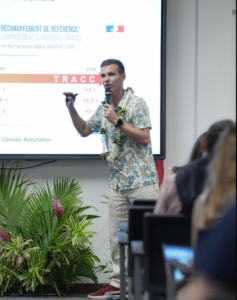
Jérémy GUERBETTE ©Fabrice CHARLEUX
Another trend highlighted by the project is likely to make living conditions across the South Pacific archipelagos increasingly challenging: the rise in the number of very hot days, defined as days when maximum temperatures exceed 32°C. Although all territories are expected to experience an increase in such events, the intensity of this change will vary geographically. Leeward coastal areas and mountainous regions are projected to be particularly affected by prolonged periods of extreme heat.
Despite these advances, uncertainty remains regarding future rainfall patterns. Climate simulations reveal a high level of natural variability, preventing the identification of a robust long-term trend by the end of the century. At this stage, the different climate models therefore do not provide conclusive evidence of consistent changes in precipitation regimes across the territories under study.
The AROME regional climate simulations were then presented in greater detail by Amarys Casnin for French Polynesia and Hong-Hanh Le for New Caledonia and Vanuatu. Their presentations focused in particular on the bias-correction methodology applied to calibrate the climate models before producing the final projections. This crucial step substantially improved the reliability and accuracy of the simulations, making it possible to generate high-resolution projections of future climate conditions across the coming decades.

Hong-Hanh LE, ©Fabrice CHARLEUX
Building Adaptation With and for Local Communities
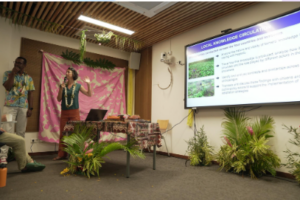
Samson JEAN-MARIE and Catherine SABINOT ©Fabrice CHARLEUX
Catherine Sabinot presented the findings of three and a half years of field research conducted across the four territories included in the CLIPSSA project, alongside Ida Palerne, agronomist specialising in local knowledge in Vanuatu, and Samson Jean-Marie, PhD candidate in anthropology and geography focusing on local knowledge in New Caledonia and Vanuatu. Their research examined how local agricultural knowledge is created, shared and continuously renewed, with the objective of integrating this knowledge into the adaptation strategies currently being developed by public authorities.
The findings are based on a combination of field observations, participant observation, semi-structured interviews, and participatory workshops conducted with farmers across the study sites, as well as with local residents, territorial, provincial and municipal technical officers, and customary authorities. One of the project’s key findings is that local communities possess what researchers describe as a “risk culture”: a body of agricultural knowledge and practices developed over generations that enables farmers to cope with climatic hazards. This body of knowledge has been shaped through repeated experience of extreme events and continues to evolve in response to ongoing environmental change.
Rather than remaining static, this risk culture is constantly adapting. New knowledge continues to emerge, while the places and contexts in which it is transmitted are themselves evolving as communities respond to increasingly frequent and intense climatic hazards. Local agricultural knowledge draws upon a wide range of complementary sources. Practical experience acquired through farming, customary and cultural knowledge, technical and formal education, as well as information shared through the media and social networks, all contribute to the continuous evolution of agricultural practices.
The transmission of this risk culture occurs across a wide diversity of “knowledge spaces and moments”—that is, the different settings in which knowledge is exchanged. These spaces vary according to their degree of formalisation and the extent to which they are collective. Some are formal settings, such as agricultural training sessions or technical meetings. Others are far more informal, with knowledge being shared within families, during journeys by car, in local markets or directly in the fields while working together.
Several factors either facilitate or constrain these processes of knowledge exchange. Among the most influential are the social organisation of communities and the material resources available to them. Shared experiences of climatic hazards, collective memories of past events, and the experience of facing similar challenges together also play a central role in strengthening knowledge transmission. Finally, the cultural significance attached to particular crop species or cultivated landscapes strongly influences how knowledge circulates. Depending on the local context, these cultural dimensions may either facilitate the dissemination of agricultural knowledge or constitute barriers to its transmission.
One of CLIPSSA’s major contributions has been the development of a comprehensive database documenting local agricultural knowledge and practices. By bringing together all of the information collected during fieldwork, this database provides an unprecedented resource for understanding the adaptive capacities of Oceanian farmers. The knowledge generated through this research offers public authorities valuable evidence for designing future adaptation strategies, thereby helping to strengthen the long-term resilience of agriculture across the South Pacific.
Farming in the South Pacific
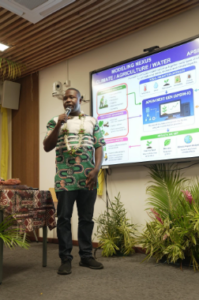
Dakéga RAGATOA ©Fabrice CHARLEUX
Dakéga Ragatoa, agro-climatologist and researcher specialising in modelling the impacts of climate change on major tropical root and tuber crops in Wallis and Futuna and French Polynesia, presented the results of his research, alongside those of Gildas Guidigan, agro-climatologist and researcher responsible for modelling the impacts of climate change on agriculture in New Caledonia and Vanuatu.
Their studies projected future yield trends for taro, yam and, depending on the territory, cassava. These crops were selected following a year-long consultation process with stakeholders from the territories involved in the project. Only a limited number of varieties were retained for the simulations, corresponding to the species that are most representative of the agricultural systems under study. They were identified through a combination of literature review and field surveys conducted as part of the CLIPSSA project.
The simulations were carried out using the APSIM-X crop modelling platform, which was used to assess future changes in agricultural yields under projected climate conditions. The model relies on datasets generated by the project’s different research components. Climate projections produced within the Climate Science work package provide the climatic inputs, while information on soil characteristics and farming practices comes from the Social Sciences and Humanities (SSH) research. These datasets are combined with crop-specific agronomic parameters for each of the species modelled.
The results indicate a future decline in yields for all the crop species studied across the four territories. However, both the magnitude and timing of these changes vary according to the territory and the crop considered. In Wallis and Futuna, the simulations project a gradual decline in the potential yields of all the crops studied. This downward trend becomes apparent from the middle of the century onwards and is accompanied by an increasing number of years characterised by poor harvests.
For Tahiti and Moorea (French Polynesia), projected yield reductions are particularly pronounced for taro, whereas the yam varieties included in the study appear to be considerably more resilient to future climatic conditions. In Vanuatu, the first simulations indicate a decline in taro yields by around 2050. However, these results are currently based solely on the 2.5 km AROME climate simulation, which limits the assessment of uncertainties. Confirming this trend will therefore require additional simulations incorporating multiple climate models. Despite these territorial differences, the simulations converge on several key findings. Across all territories studied, increasing temperatures emerge as the principal driver of declining agricultural productivity. The projections also indicate that the impacts become particularly pronounced from the 2040s onwards, identifying the period around 2040-2050 as a critical turning point for agricultural systems throughout the South Pacific.
Beyond quantifying future impacts, these studies also identify a range of practical adaptation pathways to support the development of territory-specific adaptation strategies for the coming decades. These include the selection of crop varieties that are more tolerant of higher temperatures, adjustments to planting calendars, diversification of agricultural production, the development of agroforestry systems, and, where local conditions become less favourable, the relocation of certain crops. Many of these adaptation measures have already demonstrated their effectiveness in the past. As documented by the Social Sciences and Humanities research team, they are rooted in existing local agricultural knowledge and therefore provide valuable foundations upon which future adaptation strategies can be built.
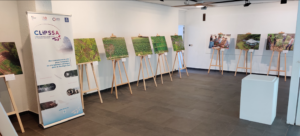
Alongside the scientific presentations, a photographic exhibition based on the work of IRD filmmaker Jean-Michel Boré, previously displayed at the Te Fare Iamanaha – Museum of Tahiti and the Islands, was installed at the University of French Polynesia. Over the four-day event, participants and students were able to visit the exhibition in the university’s research building, extending CLIPSSA’s presence beyond the conference itself while showcasing the territories and communities that lie at the heart of the project.

©Fabrice CHARLEUX
©Fleur VALLET