Update 2022 : Initial presentations and awareness-raising

Participation in international scientific events

The year 2022 was marked by the CLIPSSA project’s active participation in a number of international scientific and institutional events. At the start of the year, the project team produced a poster for the 13th International Conference on Southern Hemisphere Meteorology and Oceanography (ICSHMO) in February. In April, the Météo-France Interregional Office in New Caledonia and Wallis and Futuna gave a brief presentation on the project at the 10th session of the Pacific Islands Climate Outlook Forum (PICOF-10).

In November, at COP27 in Egypt, Christophe Menkès was an expert panellist at the French Pavilion during the side event ‘Managing and measuring adaptation in a context of climate emergency’ organised by AFD, Expertise France, IDDRI and FERDI. The project and its main objectives were presented at the round table.

Round table at the Pavillon France, 11 November 2022

Other noteworthy events involving the CLIPSSA team took place in New Caledonia, including the Loyalty Islands Province Economic Forum (September and October), the Tech&Bio trade fair and the disaster risk prevention and management day (October).

Presentation and debates on disaster risk management and reduction at the launch of the disaster risk policy in Nouméa, Château Royal hotel, 13 October 2022

Awareness-raising and outreach activities

In parallel with these commitments, CLIPSSA has carried out a number of awareness-raising and popularisation activities, notably through film debates in New Caledonia, such as the film-debate on the Empreinte programme on the theme of climate change in March. The project was also highlighted in the documentary ‘Un paradis en péril, produced in collaboration with JADA Productions and the IRD.

Extract from the Empreinte programme, available for replay on youtube

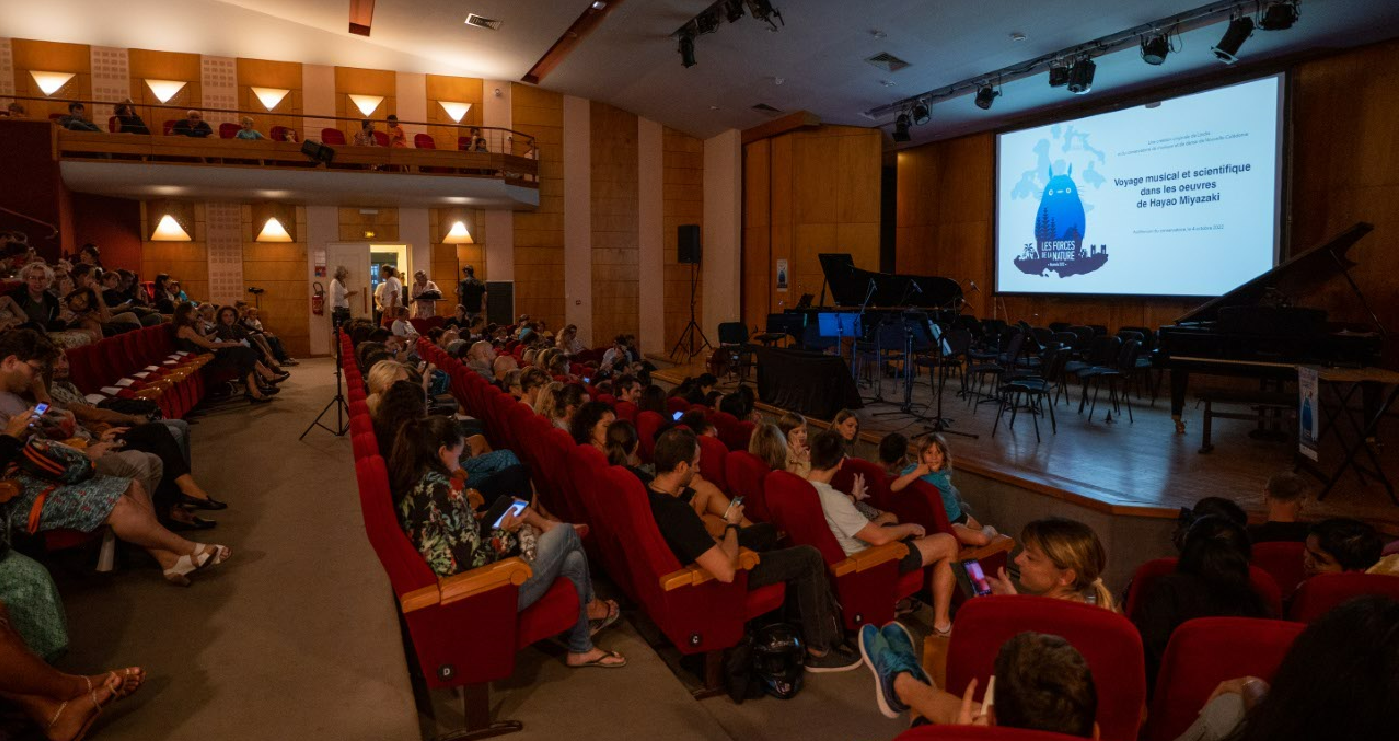
CLIPSSA took part in a project combining art and science based on the works of Myazaki, entitled ‘The Forces of Nature – A Musical and Scientific Journey through the Works of Hayao Miyazaki’, which took place in October at the Auditorium of the Conservatoire de Musique in Nouméa. The main theme was climate change and its impact, with scientific and university presentations (IRD, UNC, Institut Pasteur, Météo-France) in film/concert/lecture format. To find out more, see the specific article here !

The Fête de la Science 2022, organised in November, saw CLIPSSA make an active contribution, in partnership with the Caledonian Energy Agency, through the Fresque du Climat workshops and mini-conferences on climate change at the University of New Caledonia in Nouméa and Bako (Koné). In French Polynesia, Victoire Laurent, head of the climate division at the DIRPF-MF, has been chosen as Ambassador. Some of the Météo-France teams worked on a number of issues, and a number of activities took place, including a review of climate change and its impacts (extremes, cyclones, rainfall, temperature, etc.) in French Polynesia. CLIPSSA was presented at a public conference in Tahiti and Moorea and through an educational video.

Media presence

Finally, the project received significant media coverage in New Caledonia, with appearances on NC1ère and a mention in DEMAIN magazine (natural disasters, anticipating and adapting to climate change) in October, addressing the climate challenges of the future.

The impact of climate change in French Polynesia : Victoire Laurent warns in The Conversation

As part of the “Fête de la science”, a major event held every year in mainland France and the French overseas territories, Victoire Laurent, meteorologist and tropical climatology expert, delivers a hard-hitting analysis of the impact of climate change on French Polynesia. In her article published on The Conversation, she sheds light on the already visible effects of climate disruption on this archipelago, revealing data that is both alarming and instructive.

Historical climate data

Laurent highlights the importance of analysing long series of climate data in order to grasp the trends in climate change. In French Polynesia, the first rainfall measurements date back to 1853, and local meteorological archives are an invaluable treasure trove for research. By homogenising these data series, researchers can detect and quantify the signs of climate change, an essential step in anticipating future challenges.

Signs of global warming in French Polynesia

Made up of 120 islands divided into five archipelagos, French Polynesia is far from immune to global climate upheaval. Research shows that the Polynesian climate has warmed significantly in recent decades, with temperatures rising by between +0.6°C and +1.55°C depending on the archipelago. This warming is particularly marked at night. In Tahiti, for example, night-time temperatures have risen by +2°C over the last 58 years, almost twice as fast as daytime temperatures.

Cyclones down, but risks up

Although annual rainfall appears to be little affected by climate change, the article reveals a significant drop in cyclone activity over the last two decades. However, this decline does not mean the end of risks for local residents. Climate projections point to an increase in heatwaves and greater risk of drought, particularly on the high islands, by 2050. These changes could increase the vulnerability of water resources and the risk of vegetation fires. In the ocean, rising sea levels and the salinisation of freshwater lenses pose serious threats, particularly for the atolls.

The CLIPSSA project: towards local adaptation

In light of these worrying findings, Victoire Laurent has been actively involved in the CLIPSSA (CLImat du Pacifique Savoirs locaux et Stratégie d’Adaptation) project. The aim of this project is to provide very high-resolution climate simulations to help local populations develop adaptation strategies tailored to the specific cultural and geographical characteristics of French Polynesia.

Understanding the climate challenges

This article by Victoire Laurent is a powerful reminder of the urgent need to act to protect these particularly vulnerable territories in the face of climate change. It is essential reading for anyone interested in the future of island regions facing major environmental upheaval.

To find out more, read the full article here : L’impact du changement climatique sur la Polynésie française.

Video presentation of the CLIPSSA project

Pacific Climate, Local Knowledge and Adaptation Strategies Project (CLIPSSA) : Adaptation solutions for the Pacific Islands

Discover the CLIPSSA regional project, which contributes to the effort to respond to the specific climate challenges of the Pacific islands.

CLIPSSA aims to develop unprecedented scientific data on the future climate of the South Pacific (by 2100), to analyze the sectoral impacts on agricultural systems and water resources, and to produce and transmit new knowledge already existing in each territory. These new data are essential foundations for the formulation of adaptation strategies and the development of action and adaptation plans in the face of climate change in Wallis and Futuna, French Polynesia, New Caledonia and Vanuatu.

One 2-year postdoctoral position on the impact of climate change on agricultural systems in New Caledonia/Vanuatu and French Polynesia/Wallis and Futuna.

We are hiring! CLIPSSA is offering one 2-year postdoctoral contract on the impact of climate change on agricultural systems in New Caledonia/Vanuatu and French Polynesia/Wallis and Futuna.

Postdoc will be based at the IRD Nouméa centre, including missions. The deadline for applications is January 20th 2024.

More information on the job position below.

CLIPSSA_IRD_Postdoc_climate_agriculture ENG

Call for applications for a postdoctoral position in anthropology or geography

We are hiring! CLIPSSA is offering a postdoctoral contract in anthropology or geography!

The postdoc will be based at the IRD Nouméa centre, including missions in Wallis and Futuna and French Polynesia. The deadline for applications is October 15th 2023.

More information on the job offer below.

CLIPSSA Call for applications Postdoc


When art and science come together

CLIPSSA supported the event “A Musical and Scientific Journey in the Animated Films of H. Miyazaki, ” held twice, on October 4 and November 26, 2022, at the Conservatory of Music and Dance of New Caledonia. Here is a look back at a show that was well received.

On stage, 30 young musicians from the conservatory gave a masterful performance of the music of Joe Hisaishi, the faithful composer of Miyazaki’s films. At the same time, in the background, excerpts from “My Neighbour Totoro”, “Kiki the Little Witch”, “Ponyo on the Cliff”, “Nausicaa” and “Princess Monoké” were played. Majestic forests, extraordinary animals, Dantesque storms… All the extracts screened had nature or the relationship between man and nature as their theme. “Miyazaki is undoubtedly the greatest director of Japanese animated films. He draws nature like no other. I chose extracts so that the scientists could use them as a basis for popularised mini-conferences on the forces of Caledonian nature” explains Estelle Bonnet-Vidal, scientific communication consultant and organiser of the event.

Thomas Abinun, the climatologist at Météo-France, took part in the exercise and gave a mini-conference on storms and climate change. “This concert conference was a great opportunity to combine art and science and to reach a large and diverse audience. In its mission to raise awareness and share knowledge on climate change, Météo-France was happy to be associated with this event to briefly present the CLIPSSA project while reminding the public that if we continue on the current trajectory of our greenhouse gas emissions, the global sea level could rise by one metre by the end of the century, which constitutes a real threat for our island regions where many towns and villages are already very vulnerable to marine submersion,” he confided. Other scientists from the IRD, the University of New Caledonia and the Pasteur Institute spoke about biodiversity, infectious diseases and wind.

“We did not expect to attract so many people. The most pleasant thing was to see families with young children and groups of teenagers. This is an audience that is rarely seen at scientific conferences for the general public” adds Estelle Bonnet-Vidal.

As for the music, “the students loved the project from the start, and they worked all year with their flute, piano, violin, cello and clarinet teachers. We had very few rehearsals, but the harmony was there, and the audience was delighted” comments Rémy Quinne, piano teacher and musical director of the project. Nearly 700 Caledonians came to see the two performances and particularly appreciated the original blend of cinema, classical music and science.

Caroline Edant, Biodiversity-Climate Officer at Agence Française de Développement (AFD), said: “AFD supported this original and ambitious creation through the CLIPSSA project, and we are very proud to have done so with our partners from IRD and Météo-France. This event raised awareness of the issues of biodiversity and climate change through a sense of wonder. I want to salute the boldness and commitment of all the participants, from the scientists to the musicians, as well as the organisers and other sponsors”.